








Once food is swallowed, it travels down the esophagus to the stomach, where digestion begins, and then travels to the small intestine, where significant nutrients are absorbed. The food waste travels to the colon, where water is absorbed, while the rectum acts as a holding bay for the stools until they are eliminated via the anus.
The colon consists of 4 parts: the ascending, transverse and descending colon, and the sigmoid colon (see image 1). The rectum is the last segment of the large intestine, which leads to the anus and measures 15 cm in length.
In order to describe the position of a tumor in the rectum, we usually divide it into three parts: the upper, middle and lower third. The upper rectum is located immediately beneath the sigmoid colon and the lower rectum is in the area where the large intestine enters the anus.
The rectal walls consist of tissue layers. Cancer starts developing in the interior layer (mucosa), but as it spreads it infiltrates the other layers and can come out into the fat that surrounds the rectum. In more advanced stages it can infiltrate neighboring organs and lymph nodes and/or metastasize to remote areas of the body.
Most cancers develop slowly over a number of years and start as small benign lesions known as polyps. A small percentage of colorectal cancers (mainly hereditary forms) may create a large number of polyps, but these forms are rare. In the early stages, the disease remains within the organ, but in more advanced stages it tends to metastasize, primarily to the liver and the lungs.
Epidemiological Data
Colorectal cancer is the third most common cancer in Europe affecting both sexes. Overall, the chance that an individual will develop lung cancer in their lifetime is about 1 in 20. The average age for colorectal cancer is the 7th decade of one’s life.
It is the fourth most common cause of cancer-related death. In the USA it is the second most common cause of death after lung cancer. Nevertheless, death rates due to colorectal cancer have been continuously decreasing over the last 20 years. There are a number reasons for this. One reason is that screening with colonoscopy finds polyps and removes them before they can develop into cancer or cancer is detected at an early stage and is easily treated. In addition, colorectal cancer treatment has presented significant progress in recent years.
Etiological Factors

Age is the main risk factor since more than 80% of cases are individuals aged over 60 years, while the average age for colorectal cancer diagnosis is 70 years. Individuals with a family history of colorectal cancer should undergo a colonoscopy every 5 years after the age of 40.
There are also well-documented risk factors for the development of rectal cancer, such as inflammatory intestinal disorders (e.g. ulcerative colitis, Crohn’s disease). In this case, patients should undergo a colonoscopy every 1-2 years.
In addition, rare hereditary conditions that are frequently linked to the development of rectal cancer include familial adenomatous polyposis and Lynch syndrome.
Significant risk factors include obesity, lack of physical exercise, alcohol abuse and diets that are rich in animal fats and poor in fiber and antioxidants. At this point, we understand the value of the traditional Greek, Mediterranean diet, which many studies have shown, shields the body and offers longevity.
Symptoms

Colorectal cancer is usually asymptomatic and most times symptoms are indicative of advanced disease. Thus, early diagnosis as referred to below and an immediate medical assessment, if there are symptoms, are significant.
- Changes in bowel habits (alternating between diarrhea and constipation)
- Rectal bleeding or bloody stools
- Bloating and persistent abdominal discomfort or pain
- Unexplained weight loss
- Chronic fatigue
- Anemia
The rule of thumb is that rectal bleeding must be investigated and not attributed to hemorrhoids without a thorough check-up.
Diagnosis

There are a number of diagnostic methods and tests for assessment and early diagnosis.
- Physical examination and digital rectal examination (for the possibility of lesions)
- Fecal occult blood test
Rectosigmoidoscopy and colonoscopy (offers an inside view of the organ for the presence of polyps or masses and if needed, biopsy is possible).
If rectal cancer has been diagnosed
- The use of transrectal ultrasound offers significant information in terms of tumor staging.
- Magnetic resonance imaging (MRI) can provide additional information in terms of tumor staging.
Treatment
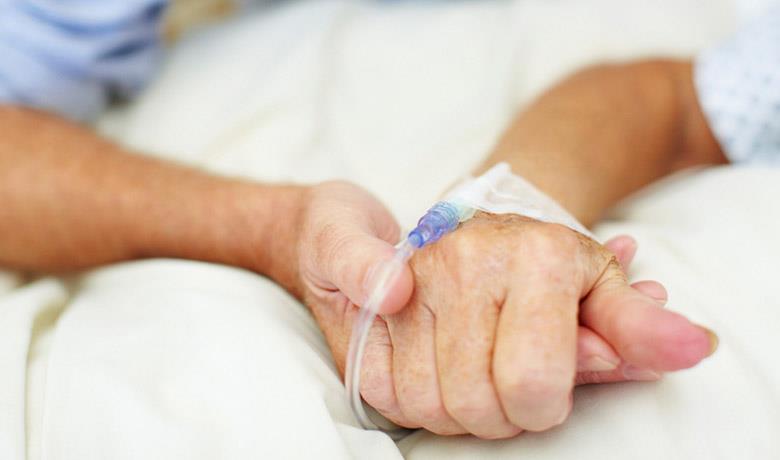
Surgery is the primary approach for cancers of the large intestine and the rectum. It is worth noting that in the early stages, surgery alone may treat the disease without the need for additional treatments. Depending on the localization and stage of the disease, radiation therapy and/or chemotherapy may be necessary prior to or after surgical intervention.
When radiation therapy is delivered prior to surgery (preoperative radiation therapy), it may salvage the sphincter when the tumor is located very close to the anus, thus avoiding permanent colostomy. In addition, this treatment strategy reduces the risk of disease recurrence in that area (reduction of local recurrence).
It is important for the treatment decision to be taken after the patient is informed about treatment options (preoperative or postoperative) and any associated complications or toxicities.
Radiation Therapy
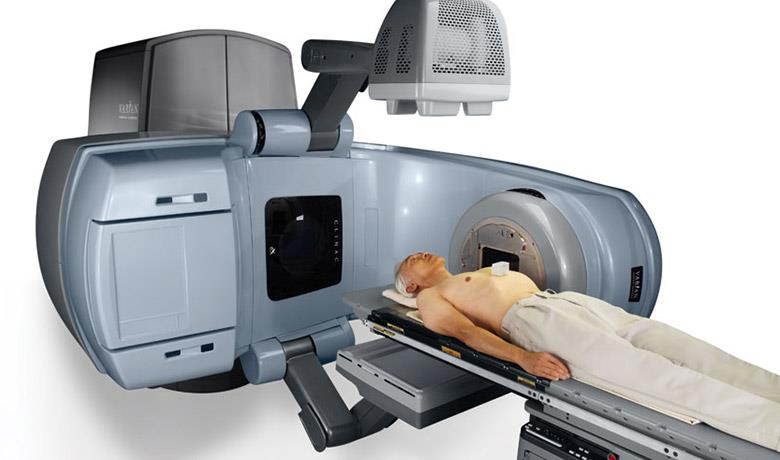
Radiation Oncologists use radiation to treat cancer, to control the size of the tumor, but also to relieve some symptoms, such as pain. Radiation acts on the cancer cell interior by destroying their ability to proliferate. When these cells die they are naturally discarded by the body. Healthy cells are also affected by the radiation, but unlike cancer cells, they are able to repair themselves from the damage that they have undergone.
External beam radiation therapy is performed over a number of daily visits to our Center on an outpatient basis (without hospitalization). EBRT uses high-energy X-rays (photons). The rays are produced by a linear accelerator, positioned at a distance from the patient’s body.
Three Dimensional Conformal Radiotherapy (3D-CRT) is the most frequently used external beam radiation therapy technique, while Intensity Modulated Radiotherapy (IMRT), an improved version of 3D-CRT which focuses the dose on the target and avoids healthy tissues, has been increasingly gaining ground over recent years.
The application of IMRT made using state-of-the-art and more precise image guided radiotherapy (IGRT) of the targeted area prior to the radiation therapy all the more necessary.
Focusing on high-dose radiation on a tumor, with less impact on healthy organs, but also the safety that these doses will be precisely delivered to the target, have established radiation therapy an extremely safe treatment method. Contemporary radiation therapy techniques have managed to reduce side effects in the gastrointestinal system (e.g. diarrhea) and urinary system (e.g. frequent urination) to a minimum and even if they do appear they are minor and can be treated shortly after radiation therapy in completed.
Side Effects

Combination chemotherapy and radiation therapy is used for treating colorectal cancer patients. Side effects that may appear in the abdominal area during treatment are due to radiation therapy, while others (systemic) are due to chemotherapy.
- The most common radiation therapy side effects include diarrhea episodes, abdominal cramps, feeling of pressure in the rectal area, frequent urination, burning (stinging) sensation while urinating, skin irritation, nausea and feeling of fatigue. These symptoms are temporary and gradually subside after treatment is completed.
- Chemotherapy side effects depend on the type of drugs used and will be discussed with your medical oncologist.
- These treatments may affect your ability to have children and this must be discussed with your doctor.
- The side effects are not the same for all patients and many of these may be controlled with medication or a change in your diet.
- Keep in mind that patients undergoing radiation therapy do not emit radiation themselves, so people who come into contact with them, including pregnant women or small children, are absolutely safe.
Caring for yourself during treatment
When patients undergo cancer treatments they are tried both physically and mentally. Take care of yourself:
- Get plenty of rest
- Follow medical instructions
- Eat a balanced diet
- Take care of your skin in the irradiated area
- Ask for help and support from family and friends, but also from cancer patient support groups
Our Approach
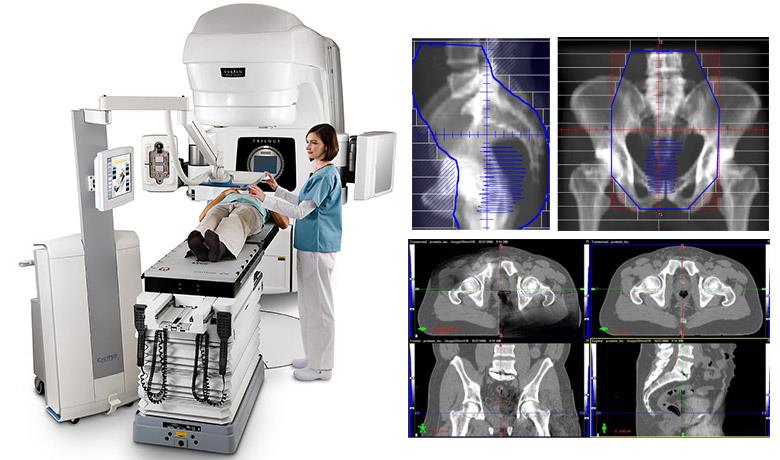
As soon as you visit the Metropolitan Hospital Radiation Oncology Center, you will be approached by a dedicated team of specialists, who will tailor the treatment to your individual needs.
Other than radiation oncologists, this specialized team includes: the medical physics department, which consists of radiophysicists who specialize in the latest radiation therapy technologies, radiologic technologists, nursing staff specializing in oncology and secretarial staff.
Our team also works closely with all the medical specialties involved in colorectal cancer, such as surgeons, gastroenterologists and medical oncologists, but also radiologists and anatomic pathologists. This guarantees the most individualized, modern and effective treatment, with the least possible side-effects. This impeccable collaboration is further forged through the Hospital’s weekly Oncology Council meetings, with the participation of staff from all the relevant medical specialties.
The state-of-the-art radiotherapy techniques and the skills acquired by the doctors from their training in centers of excellence in Europe and the USA ensure highly accurate and targeted tumor treatment, by delivering the maximum radiation dose possible, with the least damage to healthy cells.
At Metropolitan Hospital we offer state-of-the-art radiation therapy techniques to treat prostate cancer. These include:
- Three Dimensional Conformal Radiotherapy (3D-CRT)
- Intensity Modulated Radiotherapy (IMRT)
- Image Guided Radiotherapy (IGRT)
- Fusion of CT planning images with MRI images